When Americans think of Europe, they think of the major/capital cities like London, Paris, Rome, Athens. Most families go for about two or three weeks because they want to hit all the major sight-seeing spots like the Eiffel Tower, the islands of Santorini, or a boat ride in Venice, but enjoy the beauty and history of the land that are likely to only see once in their lifetime because these trips can be costly. Historical significance seems to be another theme in the European travel guide because Americans like to see architectural marvels from before the time of Christ and other attractions that were considered ruins long before our Founding Fathers had been born. America is ethnically and culturally diverse, perhaps like no other nation in the world and Americans want to see something that is distinctly Irish or German or Polish so they can see what their traditions have evolved from; the original model, if you will. Americans want to see places where they have only read about or heard stories of. they want authentic Italian food from Italy, they want beer from Germany and maybe even some croissants in France in the shadow of the Eiffel Tower. Americans, like Europeans, want to see major attractions, world wonders, places to go and objects to see before you die, but even though they have read about and possibly seen it on television, actually experiencing it in person is much more powerful and an everlasting memory, which is ultimately what Americans desire when they travel Europe.
Europeans traveling to America are bombarded with many different options across the country, but it depends what part they intend to visit, but if they want to go coast to coast, one travel site has the Grand Canyon, Universal Studios, and Red Rock Canyon in Colorado as their top three overall destinations in the U.S. Others on the list include Miami Beach, Ground Zero in NYC and Sea World. It seems as if the travel agencies are catering to the likes of the Europeans or other foreigners in showing a healthy mix of natural grandeur and man-made marvels. the Golden Gate Bridge, Hollywood and Central Park in NYC as well as the Statue of Liberty seem to be other highly attractive places in which Europeans don't often see in their own lands because of the famous architects or brilliant minds who helped develop the relatively new country in America. Europeans seem to like the natural beauty that has been there for millions of years, along with the mix of new technology and design in America, seeing as how it is a couple of thousand years the junior of most of the established sight seeing spots of Europe. Some Europeans may even come to see the art that is seeing 8 million people try and traverse 469 square miles of NYC, while getting to their destination on time. Others may just come to see all those people and then drive 30 minutes out of the City and see farmland as far as the eye can see. Beaches, architectural marvels and even museums are commonplace amongst the travel guides for the United States, which leads one to believe those traits are what make America is distinctly American because the variety and input from a vast array of cultures and nationalities, not found in Europe because those are the origins of America; the United States just brings all those idea into one place, making the diversity and variety in a comparably small area unique to America. America has some of the most publicized history, of which is also targeted and such powerful building in Washington, D.C. are also sights to been seen, not only for their beauty, but because the most powerful people in the world work there everyday.
Europeans have the notion that America is still young and new, but that is part of the attraction as well as the diversity of culture and nationality that makes America the melting pot it is, which is what many European come here for, in my opinion. I think the themes of diversity and grandeur have been clearly laid out as the two main reasons Europeans come to experience America, which would be, in my view, correct values to place on the United States.
Monday, October 18, 2010

Monday, October 11, 2010
NYC/London
 London has a distinct, royal look to it, mainly because a great succession of royal families have built it over the last several centuries to what we see today. the buildings are very ornate and represent the 16th, 17th, and 18th century tastes of style and architecture of the periods in which they were built. The designs on the stone buildings is very ornate and the stone buildings are commonly found throughout the city. The Royal taste was only for the best materials to be used on such buildings as the British Parliament buildings (which is the orange-looking one on the left) and other Royal/government buildings. Not many of the structures look to rise above 10 stories. It also appears that London appears to maintain as much greenspace as possible, especially along the body of water that runs through the
 city.


It seems that London maintains is Royal appearance because the people that live there, mostly are English, and the people who make the decisions about the landscape of the city enjoy their English roots. New York was at one time the largest immigrant center int he world and the type of architecture that is shown in NY is because of the different ideas coming from varying parts of the world.
Monday, October 4, 2010
Buffalo's West Side
I chose the West Side of Buffalo, particularly because my father's side of the family all lived on the West Side at one point during the early to mid 20th century. The West Side has always been well known for its strong Italian heritage and population. While Italians still remain on the West Side, running a handful of restaurants, the Hispanic population has mostly made it their own enclave.
 Even though the West Side is predominantly Puerto Rican, many African American, Middle Eastern, Central American, Somali, and Burmese immigrants currently live there. Unlike many other parts of Buffalo, the West Side still has many factors going in its favor like Buffalo State College and Kleinhans Music Hall. However, the neighborhood itself, is older than it looks because the money isn't there to fund for repairs. Street after street was lined with houses that were in disrepair and buildings and lots that were vacant. even though the Puerto Ricans have made the West Side mostly their own, the Italian infastructure is still there seeing as how each house and building was built in the early 20th century, which marked the Italians biggest influx of citizens.
The houses are moderate, wood built homes, that are mostly three- stories and could house one or two families. Also, I noticed that the houses were spaced close together, which I never fully understood, but my best guess was a strong sense of community and not a whole lot of space to work with.
Buffalo was a major industrial city, with the West Side playing a pivotal role in the shipping and import of goods into the city, which is what many of the Italians did to make a living. Italians also brought their own culture with them in the way of food, of which there are still quite a few Italian restaurants left in the area, specifically Left Bank, which is located on Rhode Island St. and Mineo and Sapio Italian Sausage. However, when the city suffered suburbanization in the post- WWII era and deinsudtrialization the Italians moved to the suburbs and left what they had built behind. Still prime for immigrants some 60 years after the first wave, Puerto Ricans have made it their home in Buffalo.


 Many corner stores have their products painted on the sides of the stores, which was commonplace among the two or three corner stores that I saw on my journey. The Hispanic transformation is evident as there is now a Puerto Rican Day Parade that takes places on Niagara St., which is also known as Avenida San Juan, just like the actual one in Puerto Rico.The Niagara Cafe serves Chicken with rice and beans, which is a staple of Puerto Rican food and is a quite popular restaurant among its residents.
Even though the West Side still has a lot of work to so to make the neighborhood a place where children can roam free and large sections are not an eyesore, parts of the West Side are being kept up and are being preserved and restored. There is hope for the West Side of Buffalo, that is does not remain in urban blight and does not carry the characteristics of the post-WWII "Noir City".
The houses are moderate, wood built homes, that are mostly three- stories and could house one or two families. Also, I noticed that the houses were spaced close together, which I never fully understood, but my best guess was a strong sense of community and not a whole lot of space to work with.
Buffalo was a major industrial city, with the West Side playing a pivotal role in the shipping and import of goods into the city, which is what many of the Italians did to make a living. Italians also brought their own culture with them in the way of food, of which there are still quite a few Italian restaurants left in the area, specifically Left Bank, which is located on Rhode Island St. and Mineo and Sapio Italian Sausage. However, when the city suffered suburbanization in the post- WWII era and deinsudtrialization the Italians moved to the suburbs and left what they had built behind. Still prime for immigrants some 60 years after the first wave, Puerto Ricans have made it their home in Buffalo.

 Many corner stores have their products painted on the sides of the stores, which was commonplace among the two or three corner stores that I saw on my journey. The Hispanic transformation is evident as there is now a Puerto Rican Day Parade that takes places on Niagara St., which is also known as Avenida San Juan, just like the actual one in Puerto Rico.The Niagara Cafe serves Chicken with rice and beans, which is a staple of Puerto Rican food and is a quite popular restaurant among its residents.
 Even though the West Side still has a lot of work to so to make the neighborhood a place where children can roam free and large sections are not an eyesore, parts of the West Side are being kept up and are being preserved and restored. There is hope for the West Side of Buffalo, that is does not remain in urban blight and does not carry the characteristics of the post-WWII "Noir City".
Wednesday, September 29, 2010
Parking Meters Today
Finding information about Parking meters was hard enough, especially because with the new technology, there are many different kinds of meters and models. It wasn't so much the meter itself that interested me, but the jobs, financing and other technologies that had to do with paid public parking in general.I checked out a New York Times article that had to do with parking meters in their infancy, but that wasn't my focus, so I entered "parking meters" in the search field of the NY Times site and found a rather interesting article on the City of Chicago and their steps to privatize public parking, but brought the city something like $1.2 billion in revenue, which was a foundation of the City's budget, seeing as how it was such a large sum of money and Chicago, like everyone else is trying to refine their budget in the economic times. After I got useful information that article I began to look back in the search terms and found one more on San Francisco and the common theme among the various articles was that public parking was so much a part of large cities budgets, they probably couldn't do without it. Also, I found that these larger cities were all looking to somehow make the parking business more efficient through the use of technologies to make it easier for patrons to pay, easily find a spot and increase the turnover of parking spaces that were vital to a city's economy. I had never realized, living in Western New York, where the parking meter technology isn't exactly state of the art, how much effort was going into making the burden fall less onto the patrons and more into the hands of a municipality.
My next task was to find the different variations of public parking throughout the U.S. and even in other countries. On a whim, I did a Google search and came up with this website authored by a man who used to work for the Oklahoma City Parking Authority and was extremely interested in the different technologies and methods of controlling public parking. Unfortunately, the man died about ten years ago, but his site lives, with some useful information. For example, in the U.K handheld parking meters are used get information from the internet about people who had prepaid for a parking pass for a certain spot and knew the description of the car and the license plate number within a matter of seconds, so that no one else was allowed to take that prepaid spot. Also, the devices would allow the Parking Attendants to direct people to open spaces, also made available through a computer network. Also, in the UK as well as in America, people can pay with any form of payment -cash, credit, debit. Also, the stations where one pays for parking are starting to be more centralized, eliminating the mechanical meters that most of us think of when we envision parking meters. The new feature of these centralized stations is a printed receipt that displays the time, date, and meter location, and how much time one has purchased, instead of a meter counting down the minutes.
Overall, I was surprised at how much information there was about parking meters and how important the revenue they generate is to city pocketbooks. The man from Oklahoma City, now deceased, really gave a nice summary, which I used as a starting point for my research. His efforts were not wasted when he made that site.

My next task was to find the different variations of public parking throughout the U.S. and even in other countries. On a whim, I did a Google search and came up with this website authored by a man who used to work for the Oklahoma City Parking Authority and was extremely interested in the different technologies and methods of controlling public parking. Unfortunately, the man died about ten years ago, but his site lives, with some useful information. For example, in the U.K handheld parking meters are used get information from the internet about people who had prepaid for a parking pass for a certain spot and knew the description of the car and the license plate number within a matter of seconds, so that no one else was allowed to take that prepaid spot. Also, the devices would allow the Parking Attendants to direct people to open spaces, also made available through a computer network. Also, in the UK as well as in America, people can pay with any form of payment -cash, credit, debit. Also, the stations where one pays for parking are starting to be more centralized, eliminating the mechanical meters that most of us think of when we envision parking meters. The new feature of these centralized stations is a printed receipt that displays the time, date, and meter location, and how much time one has purchased, instead of a meter counting down the minutes.
Overall, I was surprised at how much information there was about parking meters and how important the revenue they generate is to city pocketbooks. The man from Oklahoma City, now deceased, really gave a nice summary, which I used as a starting point for my research. His efforts were not wasted when he made that site.

Monday, September 20, 2010
Village of Kenmore
I wanted to take a closer look at the Village of Kenmore, because living in Amherst, I get to see the lovely Village of Williamsville quite often, so I thought, why not?


Kenmore is a small village, only 1.2 square miles, yet was rated as one of the top 10 most desirable places to live in the United States in 2009. It has it's own police department, trash services and highway department. The stretch on Delaware Ave. from Euclid to Delaware Rd. is the part where it really feels like you can just go for a walk in a community, in the truest sense of the word. Many houses in Kenmore began being constructed in the early 1900's, with the second wave coming right after World War II. The stores that line Delaware Ave. are from between the turn of the 20th century and about the late 1940's.


This particular building is a unisex barber shop on the southeast corner of Delaware Ave. and Euclid Ave. Above the business is an active apartment that looks to be from the early 20th century because of the window crowns in the brick (better view in the top picture. The barber shop was not open when I went, but there is also a partial fire escape at the back of the building leading from the above apartment. In my opinion, I believe that at one time, the whole dwelling was a house for a well-off family that "pulled themselves up by the bootstraps" in the Industrial age. It would have been a modest home, but large nonetheless. The only discernible repair from the original design is on the front, where there is a stone facade.

 I noticed a pattern with the window crowns on the whole street and it made me think that all of these buildings were built in the same 20-year period. Also, a pattern that arose was the occupancy of apartments above the businesses. This was one of a few that had some sort of remodeling done to the front of the building to make it look more modern, but in no way changed the structure of the building.
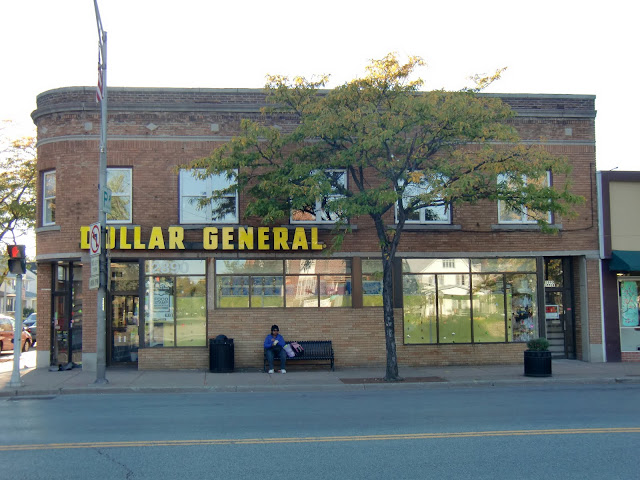 Located at the northwest corner of Lincoln Blvd. and Delaware Ave, this was a rather odd building in that it curved around the side and didn't come to a point. As one can see, the "Dollar General" sign was affixed to the front of the building and made no attempt to cover up any part of the structure as some businesses do with old buildings, part of the reason Kenmore still looks like a village because it integrates commercializing while still keeping the character of the building.
Kenmore is still a village that has a strong sense of community. Even though many cars traverse Delaware Ave. daily, they are kept in check at a strict speed of 30mph and the Kenmore Police are waiting. However, even though many buildings in the Village are from the early 20th century, Kenmore maintains a character that very few can claim, that small town feel where a family can go for a walk down Delaware or someone can ride their bike, or maybe even sit at the gazebo on the corner of Delaware Ave. and Delaware Rd. and watch the slow- moving traffic hum along. Parents don't have to fret over their children walking to school or to a friend's house because sidewalks are everywhere ( so are the stop signs) and that's what makes Kenmore remain a community-oriented village.


Kenmore is a small village, only 1.2 square miles, yet was rated as one of the top 10 most desirable places to live in the United States in 2009. It has it's own police department, trash services and highway department. The stretch on Delaware Ave. from Euclid to Delaware Rd. is the part where it really feels like you can just go for a walk in a community, in the truest sense of the word. Many houses in Kenmore began being constructed in the early 1900's, with the second wave coming right after World War II. The stores that line Delaware Ave. are from between the turn of the 20th century and about the late 1940's.


This particular building is a unisex barber shop on the southeast corner of Delaware Ave. and Euclid Ave. Above the business is an active apartment that looks to be from the early 20th century because of the window crowns in the brick (better view in the top picture. The barber shop was not open when I went, but there is also a partial fire escape at the back of the building leading from the above apartment. In my opinion, I believe that at one time, the whole dwelling was a house for a well-off family that "pulled themselves up by the bootstraps" in the Industrial age. It would have been a modest home, but large nonetheless. The only discernible repair from the original design is on the front, where there is a stone facade.


Kenmore is still a village that has a strong sense of community. Even though many cars traverse Delaware Ave. daily, they are kept in check at a strict speed of 30mph and the Kenmore Police are waiting. However, even though many buildings in the Village are from the early 20th century, Kenmore maintains a character that very few can claim, that small town feel where a family can go for a walk down Delaware or someone can ride their bike, or maybe even sit at the gazebo on the corner of Delaware Ave. and Delaware Rd. and watch the slow- moving traffic hum along. Parents don't have to fret over their children walking to school or to a friend's house because sidewalks are everywhere ( so are the stop signs) and that's what makes Kenmore remain a community-oriented village.


Subscribe to:
Posts (Atom)